Introduction
You turn the handle. Nothing happens. Or worse, you get a weak trickle, a hiss of air, then silence. It’s a strange kind of panic, standing at your sink with dishes piled up or a shower you can’t take, wondering if this is a five minute fix or a five hundred riyal plumber visit.
Here’s the good news: when water isn’t coming out of a faucet, the cause is almost always one of a small handful of things, and most of them you can check yourself in under ten minutes, no tools required.
This guide walks you through exactly why your faucet has no water, in the order you should actually check them, so you’re not tearing apart your cabinet before checking the one valve that’s actually the problem. You’ll learn how to tell a simple fix from a “call a plumber” situation, what not to do, and how to prevent this from happening again.
How to Diagnose the Problem in 3 Minutes
Before you touch a wrench, answer three quick questions. They’ll point you to the right section below and save you a lot of guesswork.
Question 1: Is it just one faucet, or the whole house? One faucet points to something local, like the aerator, the shut off valve under that sink, or the faucet’s internal cartridge. The whole house points to something bigger, like the main valve, the pressure regulator, or a municipal supply issue.
Question 2: Is it hot water, cold water, or both? Only hot water missing almost always means the water heater, not the faucet itself. Only cold water missing is less common but can mean a valve issue specific to that line.
Question 3: Did it happen suddenly, or has flow been dropping gradually? Sudden and total loss suggests a valve got closed or something broke. Gradual weakening over weeks points to mineral buildup or a slowly failing cartridge, something that shows up often in Kanzotech’s guide on brass vs. stainless steel faucets and how each material handles Saudi water conditions.
Licensed plumbers use this exact triage approach on service calls. Narrowing down “one fixture vs. whole house” and “sudden vs. gradual” gets you to the right cause faster than checking parts randomly.
1. The Shut Off Valve Is Closed or Partially Closed
This is the number one cause plumbers see for a single faucet with no water, and it’s the easiest to miss because people assume something is broken rather than closed.
Every sink has a shut off valve underneath it, sometimes two, one for hot and one for cold. These valves can get bumped closed during cleaning, renovation work, or a previous repair and never turned back on. If your home was recently fitted or renovated, it’s worth reviewing how the supply lines were connected in the first place. Our wall mounted faucet installation guide covers exactly what contractors and MEP engineers check at this stage.
How to check it:
- Open the cabinet under the sink.
- Look for small oval or round valves on the supply lines.
- Turn each one counter clockwise until it stops.
Common mistake: Forcing a stiff valve with pliers. Old valves can seize up, and excessive force can snap the stem, turning a free fix into a costly repair. If it won’t turn by hand, stop and use penetrating oil or call a plumber.
Best practice: Turn every shut off valve in your house a quarter turn once a year, even if you don’t need to. This keeps them from seizing when you actually need to use them.
2. Clogged or Blocked Aerator
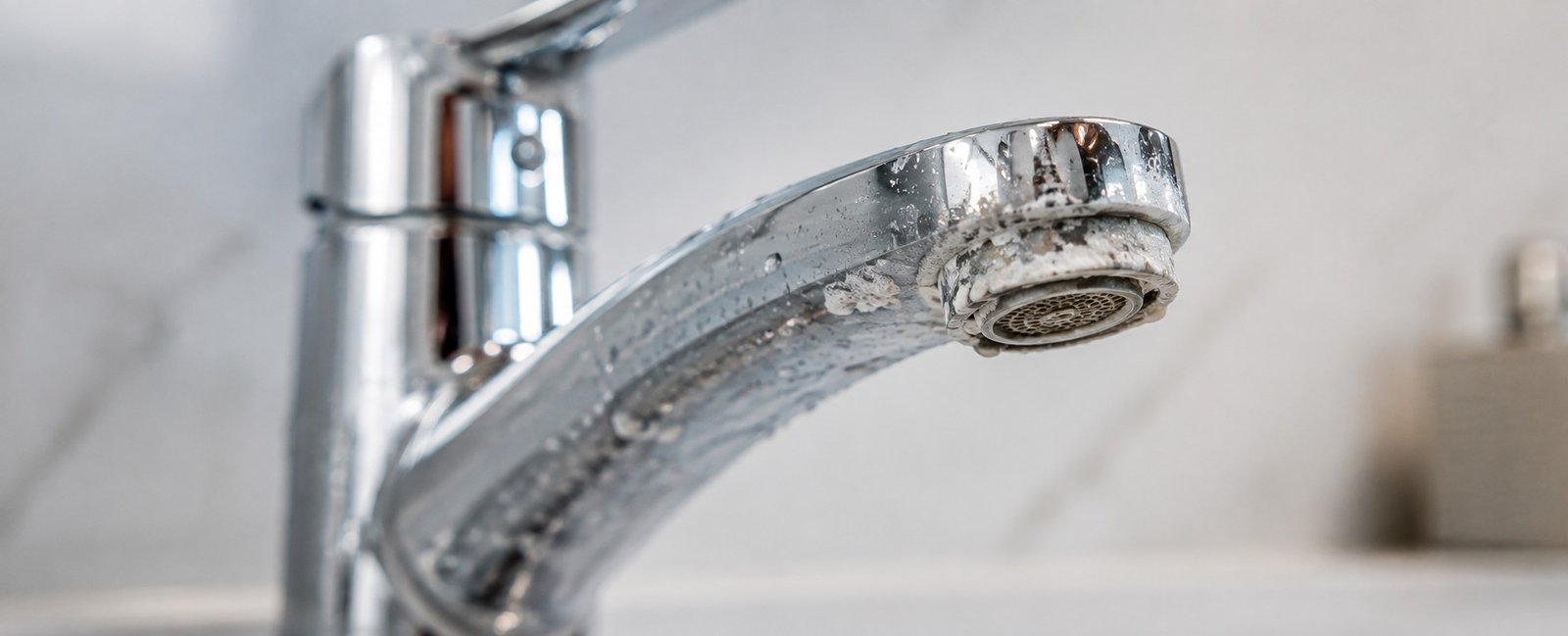
The aerator is the small mesh screen screwed onto the tip of your faucet spout. It’s designed to catch sediment, which means, over time, it catches so much sediment that water can barely get through.
This is especially common in Saudi homes, where hard water from municipal and desalinated sources leaves mineral deposits behind fast.
How to check and fix it:
- Unscrew the aerator by hand or with pliers wrapped in a cloth, to avoid scratches.
- Look inside. If it’s crusted with white or greenish buildup, that’s your answer.
- Soak it in white vinegar for 30 to 60 minutes.
- Scrub with an old toothbrush, rinse, and reattach.
Practical tip: If you don’t have a spare few minutes, run the faucet without the aerator attached. If full water pressure returns immediately, you’ve confirmed the aerator was the problem.
Common mistake: Throwing away a “broken” aerator instead of cleaning it. Nine times out of ten, a soak in vinegar fully restores it.
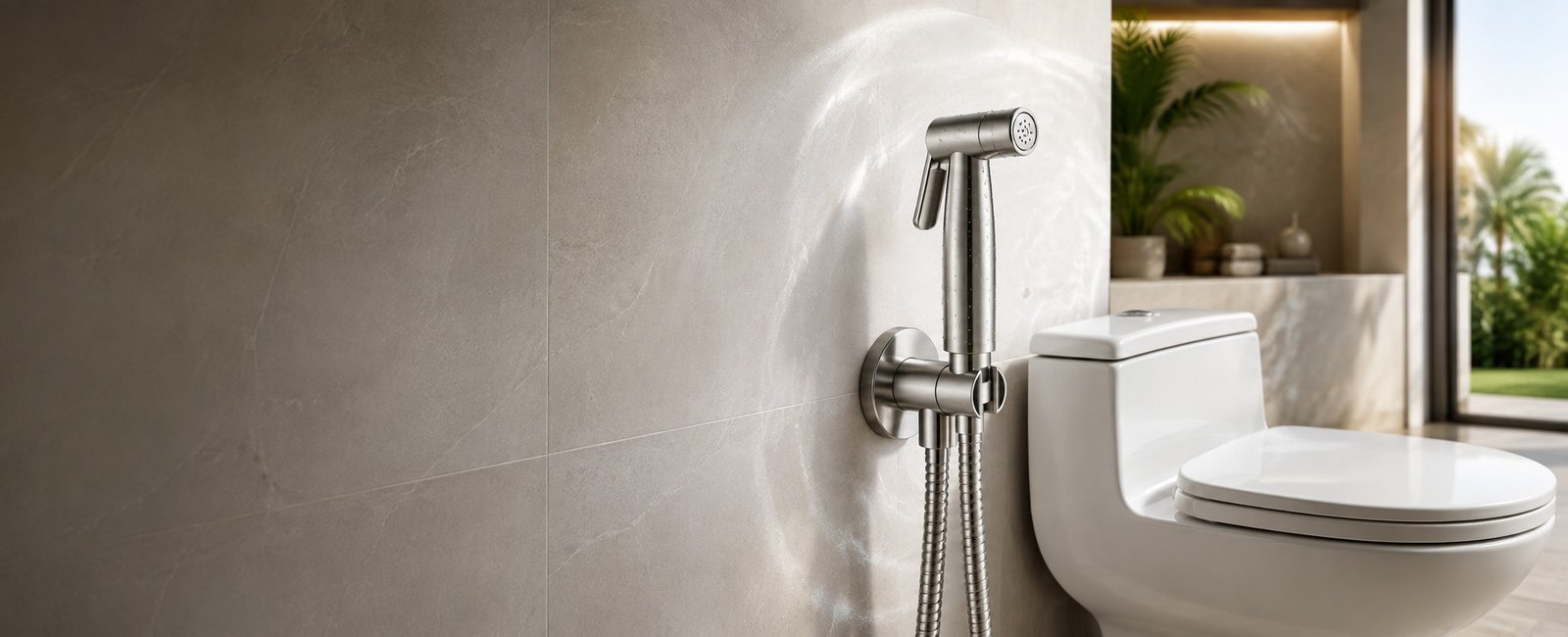
If your faucet’s aerator or spray head is scaled beyond cleaning, it’s often more practical to replace it outright. Kanzotech’s hand spray head and hand spray set ranges are built to handle exactly this kind of daily hard water exposure.
3. Sediment and Mineral Buildup From Hard Water
Saudi Arabia’s water, especially from desalinated and groundwater sources, carries a high mineral content. Over time, this buildup can narrow the inside of supply lines, valves, and faucet cartridges enough to choke off flow almost completely, long before anything looks visibly broken.
Signs this is the cause:
- Flow has been getting weaker over months, not suddenly stopping.
- You notice white, chalky buildup around faucets, showerheads, and fixtures.
- The faucet is several years old and has never been descaled.
What helps:
- A whole house water softener if you have consistently hard water.
- Periodic descaling of fixtures with vinegar.
- Choosing corrosion resistant materials to begin with. Our guide on brass vs. stainless steel faucets breaks down which material actually holds up longest under Saudi water conditions.
4. Only Hot (or Only Cold) Water Is Missing
This detail alone tells you a lot. If cold water works fine but hot water won’t come out of any faucet, the faucet isn’t your problem, your water heater is.
Likely causes when only hot water is affected:
- The water heater’s shut off valve is closed.
- A tankless water heater has gone into error or lockout mode.
- Sediment has built up inside a tank style heater, blocking flow.
Likely causes when only cold water is affected:
- The cold water shut off valve under a specific sink is closed.
- A localized blockage on the cold line only.
Practical tip: Check a second faucet in the house. If hot water is missing everywhere, go straight to your water heater and check its shut off valve and, for tankless units, its error display.
Common mistake: Repeatedly disassembling the faucet cartridge when the real issue is several meters away at the water heater.
5. Faulty Cartridge or Valve Stem
Inside every modern faucet is a cartridge that controls water flow when you turn the handle. These parts wear out, especially in single lever faucets used multiple times a day for years.
Signs this is your issue:
- The faucet handle turns, but nothing, or almost nothing, comes out.
- Flow is inconsistent, fine one day, weak the next.
- You hear a faint hissing or dripping inside the faucet body.
How to address it:
- Identify your faucet brand and model, often stamped underneath.
- Order a replacement cartridge from your faucet’s manufacturer or supplier.
- Turn off the shut off valves, then remove the handle and old cartridge.
- Insert the new cartridge and reassemble.
Cartridge wear is one of the practical differences between faucet types, and it’s covered in more depth in our single lever vs. double handle faucets comparison, which looks at how each mechanism holds up over years of daily use.
Common mistake: Replacing the entire faucet when only the internal cartridge has failed.
6. Airlock in the Plumbing System
An airlock happens when a pocket of trapped air blocks water from flowing through a pipe, often after work has been done on your plumbing, after the water was shut off and turned back on, or after a tank refill.
Signs of an airlock:
- Sputtering, spitting, or hissing from the faucet before flow stops.
- The problem appeared right after plumbing work, not gradually.
How to try clearing it:
- Attach a hose between a working faucet, like an outdoor spigot, and the affected faucet, then run water backward briefly to push the air out, only if your plumbing setup safely allows this. A good quality flexible kitchen hose makes this easier if you don’t already have one on hand.
- Simpler option: run the affected faucet at full blast for several minutes. Airlocks sometimes clear themselves under pressure.
Best practice: If you’re not confident with the hose method, this is a quick, inexpensive fix for a plumber and not worth risking cross contamination of your water supply by doing it incorrectly.
7. Water Main Break or Municipal Work
Sometimes it’s not your house at all. Water utilities regularly shut off supply for maintenance, and main breaks happen more often than most homeowners realize.
How to check it:
- Look outside. Are neighbors also without water?
- Check your local water utility’s website or social media for outage alerts.
- Call your utility’s customer service line.
Practical tip: Keep a few containers of stored water on hand for exactly this scenario. Municipal outages are usually resolved within hours but can occasionally stretch longer during major repairs.
8. Pressure Regulator Failure
If your home has a pressure reducing valve and it fails, water pressure can drop dramatically, sometimes to nearly nothing, throughout the entire house.
Signs this is the cause:
- Low pressure at every faucet, not just one.
- A pressure gauge, if you have one on your main line, reads far below the normal range.
What to do: This isn’t a DIY friendly repair for most homeowners. Replacing a pressure regulator involves working on the main water line. This is a case where calling a licensed plumber is the right first move, not the last resort.
Comparison Table: Cause vs. Symptom
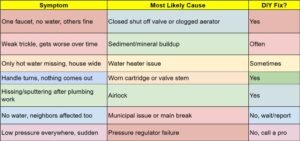
Step by Step Troubleshooting Checklist
- Check if it’s one faucet or the whole house.
- Check if hot, cold, or both are affected.
- Check the shut off valve(s) under the affected sink.
- Remove and inspect the aerator for buildup.
- Test a second faucet to rule out a house wide issue.
- Check with neighbors or your water utility for outages.
- If flow is weak everywhere, suspect the pressure regulator.
- If nothing above resolves it, suspect the internal cartridge.
- If still unresolved, call a licensed plumber.
When to Call a Professional Plumber
Some situations aren’t worth DIY-ing. Call a plumber if:
- You see water stains, bulging drywall, or active leaking.
- A shut off valve won’t turn and you’re worried about forcing it.
- The fix requires accessing pipes inside a wall or slab.
- Low pressure is house wide and you suspect the pressure regulator or main line.
- You’ve tried the steps above and still have no water.
A good rule of thumb from licensed plumbers: if diagnosing the problem requires opening a wall or working on the main supply line, it’s time to call a professional. Everything upstream of that is usually safe to try yourself.
How to Prevent This From Happening Again
- Clean aerators every 3 to 6 months, more often with hard water.
- Exercise shut off valves once a year so they don’t seize.
- Consider a water softener if you have consistent mineral buildup.
- Choose faucets and fittings built for hard water from the start. See our comparison of wall mounted vs. deck mounted faucets and our wall mounted kitchen faucets buyer’s guide if you’re planning a renovation or replacement.
- Schedule an annual plumbing checkup to catch small issues before they become no water emergencies.
Frequently Asked Questions
- Why is there no water coming out of my faucet but the toilet still works? This usually points to something specific to the sink’s supply line, like a closed shut off valve or a clogged aerator, rather than a house wide issue, since the toilet runs on a separate line.
- Why is my bathroom faucet dripping instead of flowing normally? A slow drip instead of normal flow often means a partially closed shut off valve, a clogged aerator, or early stage buildup inside the cartridge.
- Is it normal for only the kitchen faucet to lose water pressure? Yes. It usually points to a local cause like sediment buildup or a valve issue specific to that fixture, not a whole house problem.
- How do I know if my water heater is causing the problem? If cold water flows normally but hot water doesn’t come out of any faucet in the house, the water heater, not the faucet, is almost always the cause.
- Why did my faucet suddenly stop working with no warning? Sudden, total loss of water is usually a closed valve, a broken pipe, or a cartridge that failed abruptly rather than gradually.
- Do I need to turn off my main water valve to fix a faucet? Only if you’re working on the faucet’s internal parts or a supply line. Cleaning an aerator or checking under sink valves doesn’t require it.
- Why does my faucet sputter before losing water completely? Sputtering often signals an airlock or trapped air in the line, especially if it started right after plumbing work or a water shutoff.
- Can hard water really cause my faucet to stop working? Yes. Over time, mineral deposits from hard water build up inside aerators, cartridges, and supply lines, gradually restricting or blocking flow entirely. This is especially common across Saudi Arabia’s municipal and desalinated water supply.
- Is low water pressure the same problem as no water at all? Not always. Low pressure means some water is getting through but restricted, while no water means flow has stopped completely. The causes overlap but aren’t identical.
- Should I be worried if only one faucet in my house has no water? Usually not. A single affected faucet is almost always a local, fixable issue rather than a sign of a serious plumbing emergency.
Conclusion
A faucet with no water feels like a bigger problem than it usually is. In most cases, you’re dealing with one of a handful of common, fixable causes: a closed shut off valve, a clogged aerator, hard water buildup, or a worn out cartridge. Working through the diagnosis in order, one faucet vs. the whole house, hot vs. cold, sudden vs. gradual, gets you to the right answer fast, without guessing or taking things apart unnecessarily.
Your next steps:
- Run through the 3 question diagnosis at the top of this guide.
- Work through the troubleshooting checklist in order.
- If you hit a point where the fix involves your main line, wall access, or a pressure regulator, stop and call a licensed plumber.
- If the real fix is a worn part or an aging faucet, browse Kanzotech’s full faucet and accessories range for a durable, hard water ready replacement.
Still dealing with low or no water flow after trying these steps, or sourcing faucets and accessories for a project? Contact Kanzotech Faucets for guidance on the right fittings for your home or site.



 August 20, 2026
 HYZAM KENZ



Comments
No comments yet. Be the first to comment!