Introduction
One of the most common questions we get from contractors and homeowners planning a new build or renovation is a simple one: wall mounted or deck mounted? It comes up for kitchens, and it comes up separately for bathrooms and the honest answer is that it depends on the room, the fixtures around it, and how far along the project already is.
We’ve fielded this question often enough on projects across Saudi Arabia, from villa kitchen fit-outs to hotel bathroom renovations, that we wanted to lay out the decision clearly for this market specifically. A lot of faucet guides online are written for European or North American plumbing conditions, which don’t always translate cleanly here. Water supply, climate, building codes, and even typical villa layouts all shape which option actually makes sense in a Saudi project, so we’ve built those factors into this guide rather than leaving them out.
The Core Difference, Quickly
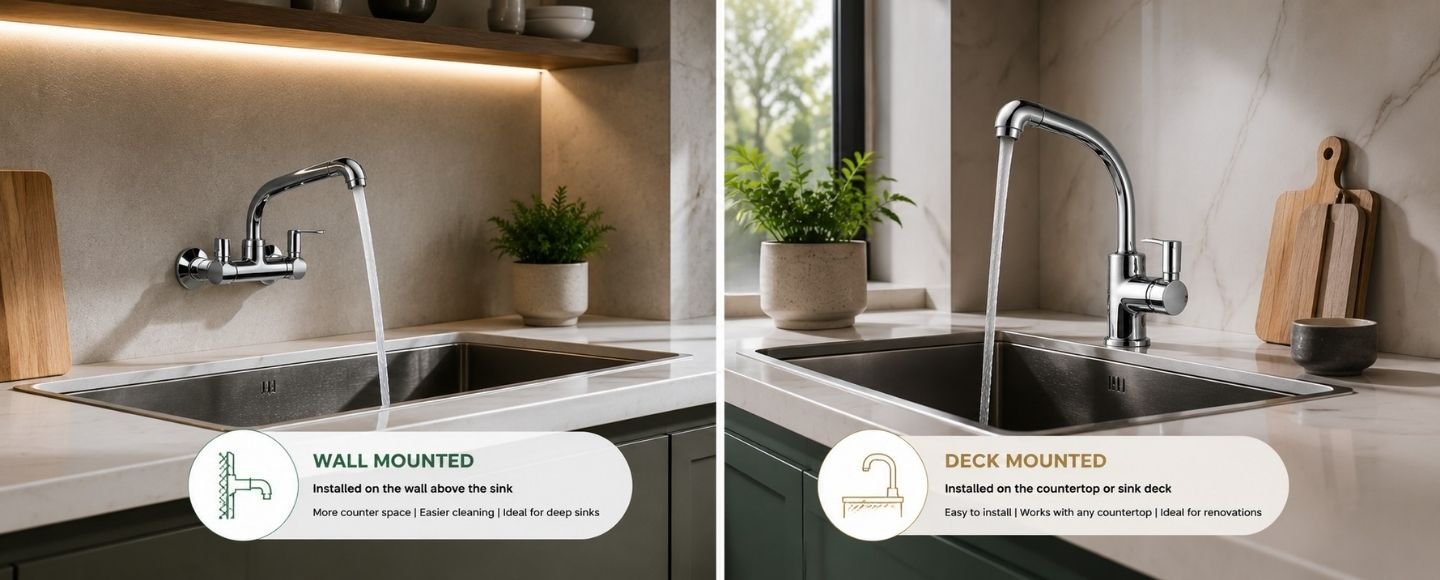
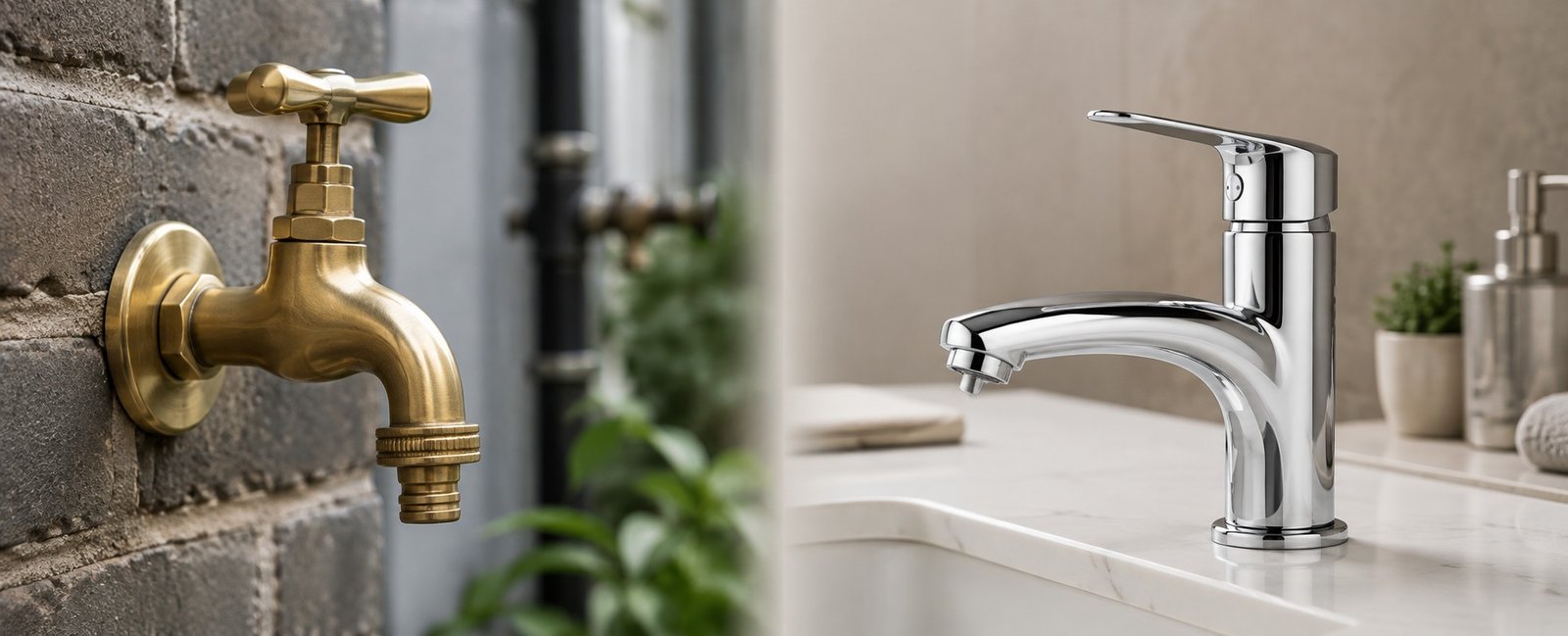
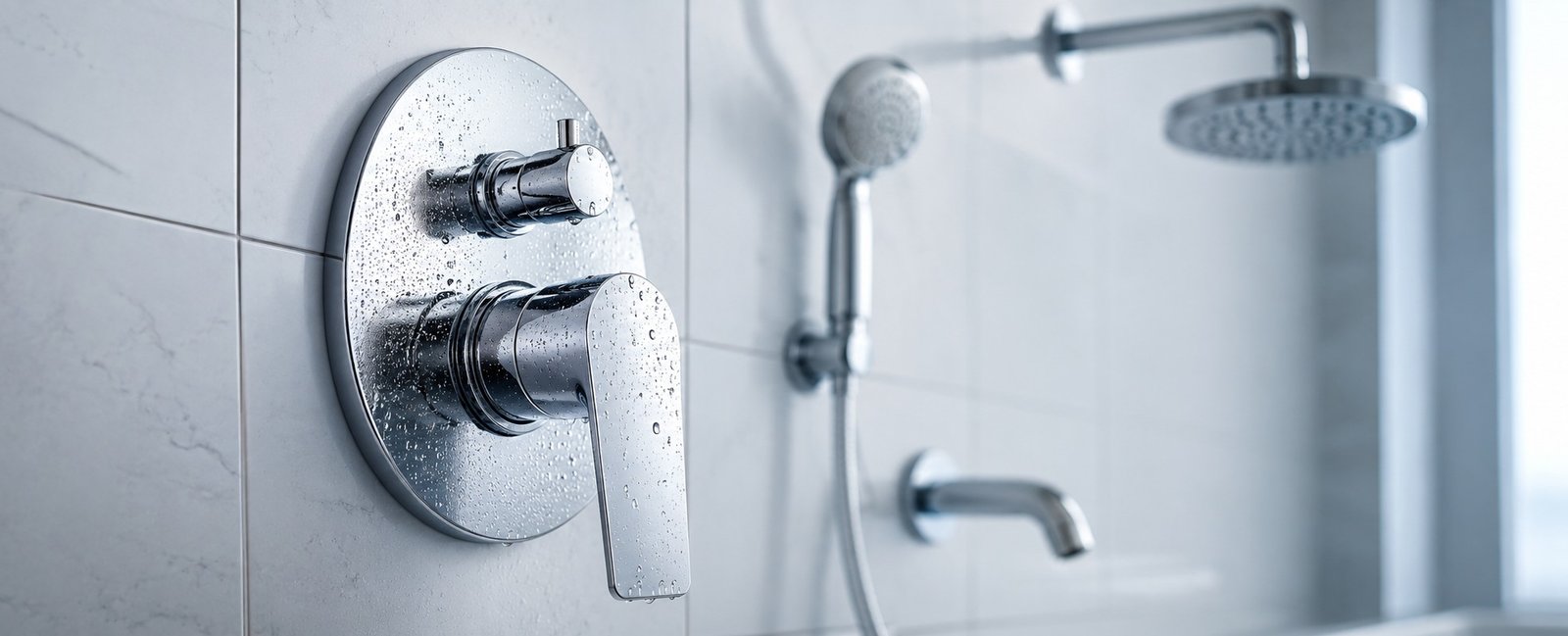
A wall mounted faucet has its body installed into the wall above the sink or basin, with supply lines routed inside the wall. Only the spout, handle, and any spray attachment sit above the fixture.
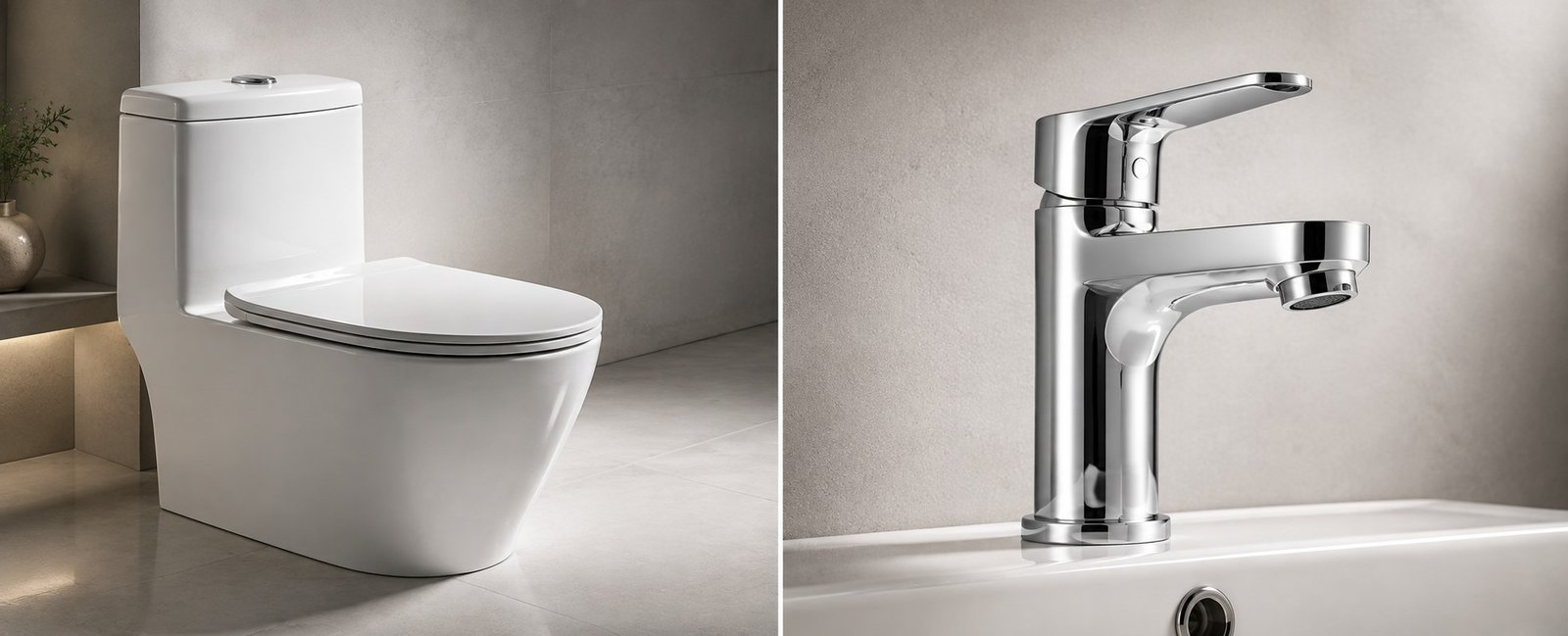
A deck mounted faucet sits directly on the counter, sink deck, or vanity top, with supply lines coming up from below through the cabinet or floor.
That’s the mechanical difference. What matters more in practice is how that difference plays out across a kitchen versus a bathroom, and how it holds up under the specific water, climate, and building conditions common across Saudi projects.
Wall Mounted vs. Deck Mounted: Side-by-Side Comparison
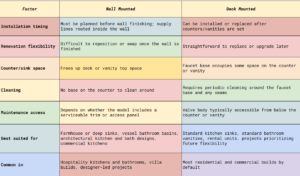
Water Quality: Why It Matters More Here Than in a Generic Guide
Most of the municipal water supply across Saudi Arabia’s major cities comes from desalination, which behaves differently from the groundwater or surface-sourced municipal water that a lot of faucet guidance assumes. Desalinated water is typically low in natural minerals, which changes the wear pattern on fixtures compared to the hard water common in many other markets. Distribution networks and any local blending or treatment can vary by city and by building, though, so actual water chemistry at a specific site can still differ from the tap water in another part of the same city.
What this means practically for faucet selection: finish durability and internal component quality matter more than they might in a market where hard water scale is the main concern. This applies to both wall mounted and deck mounted faucets equally, the mounting style doesn’t change how the fixture interacts with supply water but it’s a reason to prioritize finish and build quality over mounting style when comparing options, rather than assuming any faucet will perform the same regardless of where it’s installed.
If a project has unusual water pressure or quality concerns common in some older buildings or specific municipal zones, that’s worth raising with your MEP consultant before finalizing fixture selection, regardless of which mounting style you choose.
SASO and SBC Compliance Considerations
Plumbing fixtures sold and installed in Saudi Arabia are expected to meet relevant Saudi Standards, Metrology and Quality Organization (SASO) requirements, and installation work on residential and commercial projects generally needs to align with the Saudi Building Code (SBC), including the plumbing-specific provisions contractors will already be familiar with from SBC 701 and related sections.
We’d flag this honestly rather than gloss over it: specific SASO certification requirements and SBC clauses that apply to a given faucet model can vary by fixture type, water efficiency rating, and installation context. These are the kind of details that should be confirmed directly against current SASO documentation and your project’s SBC compliance requirements, not assumed from general product marketing. Our team can share current SASO certification documentation for specific Kanzotech faucet models on request, and we’d always recommend cross-checking this with your project’s MEP consultant before finalizing a fixture specification.
This applies equally to wall mounted and deck mounted faucets, the mounting style itself isn’t what determines compliance. The fixture’s certification and the installation’s adherence to code are what matter.
Climate and Material Considerations
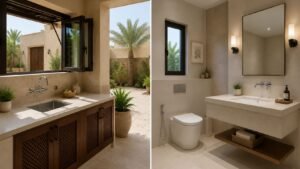
Saudi Arabia’s climate, sustained high heat, dust, and in coastal cities like Jeddah and Dammam, higher humidity and airborne salinity, affects fixture finishes over time more than it does in more temperate markets. This is a bigger consideration for faucets installed in or near outdoor-adjacent spaces, which are common in Saudi villa layouts: outdoor kitchens and prep areas near a majlis or family gathering space, and outdoor or semi-outdoor guest bathrooms.
For fixtures in these locations, finish durability against heat and dust exposure is worth prioritizing regardless of mounting style. For fully interior kitchens and bathrooms, standard indoor-rated finishes are generally sufficient but it’s still worth confirming with your supplier whether a specific finish is rated for the humidity and temperature range of your project’s location, particularly for coastal cities.
Wall Mounted vs. Deck Mounted in the Kitchen
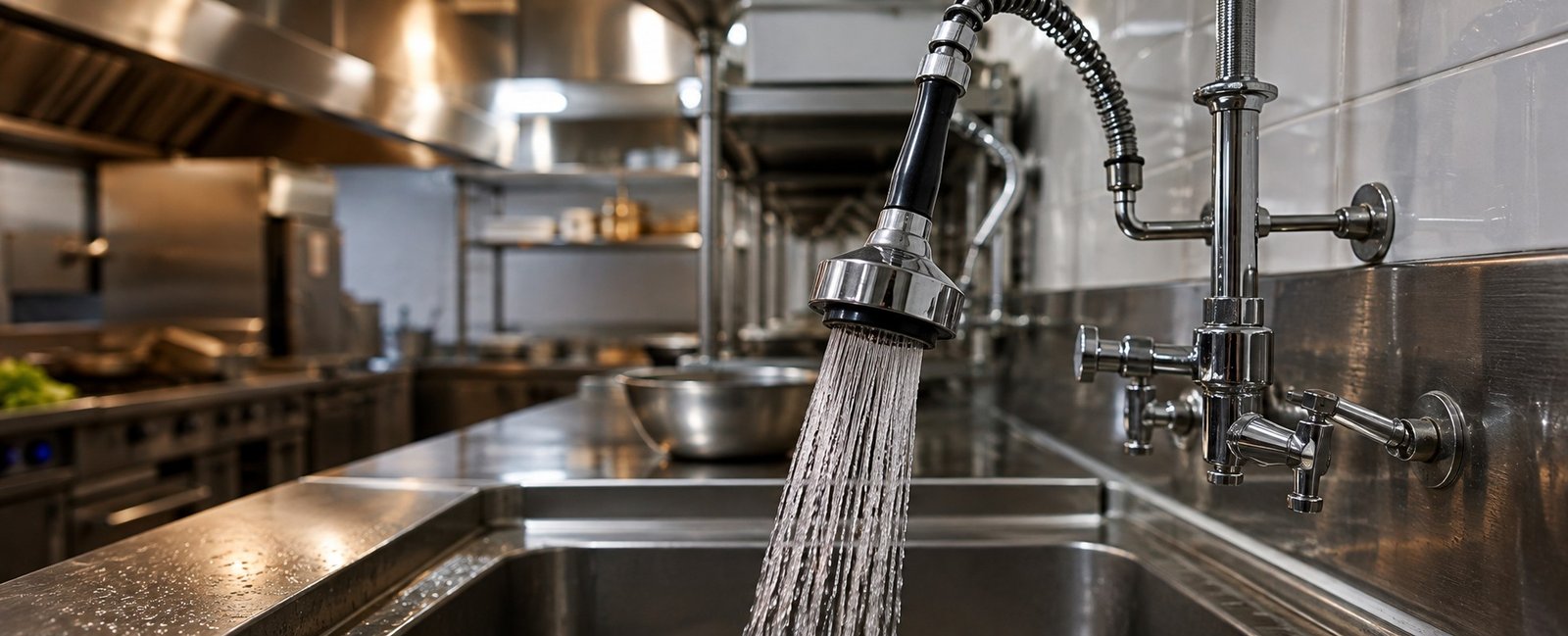
In a kitchen, the deciding factor is usually the sink itself. Deep, oversized, or farmhouse-style sinks often don’t leave enough clearance for a deck faucet to reach comfortably over the basin, a wall mounted faucet solves that by setting the spout height independently of the sink’s depth or front lip.
On villa projects we’ve supplied for, this comes up specifically with farmhouse-style sinks, which are increasingly requested in higher-end residential kitchens in Riyadh and Jeddah. A deck faucet paired with a deep farmhouse basin often sits too low relative to the sink’s front lip, exactly the kind of mismatch that gets caught late if the faucet and sink aren’t specified together from the start.
This also comes up around majlis-adjacent kitchens and outdoor prep areas, a layout feature common in Saudi villas that isn’t part of most international faucet guidance. These spaces often see heavier, more occasional high-volume use entertaining guests rather than daily cooking, which makes the cleared counter space of a wall mounted faucet genuinely useful, alongside the climate considerations noted above.
For a standard interior residential kitchen with a conventional single or double-bowl sink, deck mounted remains the more practical default. It’s easier to source, easier to replace down the line, and doesn’t require the same level of coordination between plumbing and wall-finishing trades.
Wall Mounted vs. Deck Mounted in the Bathroom
Bathrooms tend to have a different driving factor: the basin style. Vessel basins, the above-counter bowl-style sinks common in higher-end vanity designs are frequently paired with wall mounted faucets, since a deck mounted faucet often sits at an awkward height relative to a vessel basin’s raised rim.
This is one of the more common specification issues we see flagged late on hospitality projects: a vessel basin gets selected for its look, but the vanity faucet spec doesn’t get revisited to match, and the deck faucet ends up either too short in reach or positioned awkwardly against the raised basin.
It’s also worth noting that Saudi villa layouts commonly include a separate guest bathroom near the majlis, distinct from family or master bathrooms, a layout convention that shapes fixture choices differently than a typical Western single-bathroom home. Guest bathrooms in this position are often designed with a more architectural, minimal look in mind, which is part of why wall mounted faucets and vessel basins turn up there more often than in a family bathroom used daily by children, where a durable, easily serviced deck mounted faucet is usually the more practical choice.
For standard undermount or drop-in bathroom sinks in family or everyday-use bathrooms, deck mounted faucets remain the simpler and more common choice, particularly where the vanity might be updated independently of the wall in the future.
Sourcing: Why Local Manufacturing Matters for Timelines
As a Saudi-based manufacturer and wholesale distributor, Kanzotech supplies faucets locally rather than relying solely on imported stock with longer lead times. For contractors working against tight project schedules, particularly on developments tied to Vision 2030 timelines, this generally translates into more predictable availability and faster replacement of damaged or incorrect fixtures during a build, compared to importing directly from overseas suppliers on a per-project basis. Actual lead times still depend on the specific product and order volume, so it’s worth confirming stock availability with our team directly for time-sensitive projects.
Working With Kanzotech
Kanzotech supplies faucets for both kitchen and bathroom applications across residential, commercial, and hospitality projects in Saudi Arabia. We work with contractors, MEP engineers, and procurement teams to help match faucet selection, wall mounted or deck mounted, to the specific sink or basin, room type, water conditions, and project timeline, rather than defaulting to a single standard across every space.
If you’re weighing this decision for an active project, our team can walk through compatible configurations, current SASO certification documentation, and stock availability before your plumbing drawings are finalized. For related reading, see our buyer’s guide to wall mounted kitchen faucets and our installation guide for contractors and MEP engineers .
Frequently Asked Questions
1.Is a wall mounted faucet better than a deck mounted faucet for Saudi homes?
Neither is universally better, it depends on the sink or basin style, the room’s location (interior vs. outdoor-adjacent), and how much future flexibility the project needs. Wall mounted faucets suit deep or vessel-style basins, majlis-adjacent kitchens, and architecturally driven designs, while deck mounted faucets remain the simpler, more flexible default for standard family kitchens and bathrooms.
2.Do desalinated water conditions affect faucet choice?
Desalinated water, which supplies most major Saudi cities, tends to be lower in natural minerals than the hard water common in many other markets, which changes typical wear patterns. This affects finish and component quality considerations more than it affects the choice between wall mounted and deck mounted, since both mounting styles interact with supply water the same way.
3.Are Kanzotech faucets SASO certified?
Certification applies at the specific product level and can vary by model and specification, so it should be confirmed directly for the exact faucet you’re specifying. Our team can provide current SASO certification documentation on request for any Kanzotech faucet model.
4.Do outdoor or majlis-adjacent kitchens need a different faucet finish?
Fixtures installed in outdoor-adjacent spaces are exposed to more heat and dust than fully interior installations, so finish durability is worth prioritizing in those locations. This applies to both wall mounted and deck mounted options, it’s the finish and material quality that matters, not the mounting style.
5.Can I switch from a deck mounted to a wall mounted faucet later?
It’s possible, but it usually means opening the wall to route new supply lines to the correct height, since deck mounted plumbing comes from below rather than through the wall. This is why the choice is best made early, ideally at the rough-in stage.
This guide reflects general product and planning considerations for wall mounted and deck mounted faucets in Saudi kitchen and bathroom applications. Specific SASO certification details, SBC compliance requirements, rough-in measurements, and water quality conditions should always be confirmed with a licensed plumber, MEP engineer, or the Kanzotech team for your specific project and location.



 August 20, 2026
 HYZAM KENZ



Comments
No comments yet. Be the first to comment!