Best Faucets and Taps for Kitchens
There are hundreds of kitchen faucets and taps available in the Kingdom and most of the advice online was written for soft-water markets with none of Saudi Arabia’s specific challenges in mind. This guide cuts through that and tells you what actually works here.
Walk into any hardware store in Riyadh, Jeddah, or Dammam and you’ll find shelves stacked with kitchen faucets at every price point. The problem isn’t availability – it’s knowing which ones are actually worth buying in this environment. A tap that holds up fine in Germany or the UK can start dripping within 18 months here, simply because its internal components weren’t designed to handle the mineral load in Saudi water. This guide is about making the right choice the first time.
Quick Answer
The best kitchen faucets and taps for Saudi Arabia have three things in common: a solid brass or 304 stainless steel body, a ceramic disc cartridge (not a rubber washer mechanism), and a finish that handles mineral deposits without constant maintenance. Single-lever mixer taps with pull-out or pull-down sprayers are the most practical for Saudi kitchen use. Avoid zinc alloy bodies and any fitting without SASO compliance documentation.
What Makes a Kitchen Faucet Work in Saudi Arabia
Before you browse a single product, there are three environmental factors unique to Saudi Arabia that should shape every decision you make about a kitchen tap.
Hard water is unavoidable. Saudi Arabia’s water supply whether from groundwater or the national desalination network — carries significantly high levels of calcium and magnesium. This mineral-heavy water accelerates wear on rubber seals, clogs aerators rapidly, and deposits limescale on every surface the water touches. Any tap not engineered with this in mind will underperform within a year or two.
Temperature extremes stress materials. In a Saudi kitchen, cold supply water can arrive at temperatures approaching 30–35°C in summer — hot supply even hotter. Thermal cycling between these temperatures and the ambient kitchen environment puts pressure on joints, seals, and cartridge components that cheaper taps aren’t built to handle.
SASO compliance matters more than the brand name on the box. The Saudi Standards, Metrology and Quality Organization sets specific performance requirements for plumbing fixtures sold in the Kingdom. A SASO-compliant faucet has been tested against Saudi water pressure ranges and mineral conditions. It also means you have legal recourse if a commercial installation fails. Don’t buy without it.
The Saudi Kitchen Context
Saudi kitchens particularly in villas and larger apartments tend to see heavier daily use than the average Western kitchen. Extended family households, domestic staff, and cooking for larger gatherings are all common. This means your kitchen tap is working harder and more often. What that implies practically:
- Single-lever operation is much faster and more convenient under high daily use than dual-handle taps — one hand can control temperature and flow simultaneously.
- Pull-out or pull-down spray functionality is close to essential for rinsing large pots, washing vegetables, and cleaning wide sink bowls efficiently.
- 360° spout rotation is genuinely useful in double-bowl sinks — a fixed spout in a wide sink creates constant frustration.
- Aerator accessibility matters more than it does elsewhere. With hard water, you’ll be cleaning the aerator every 4–6 weeks. Some tap designs make this a 2-minute job; others require pliers and frustration.
Types of Kitchen Faucets and Taps Explained
The terminology around kitchen taps can be confusing , pull-down, pull-out, mixer, monobloc. Here’s exactly what each one means, and which is the right fit for which kitchen.
- Single-Lever Mixer Tap: One handle controls both temperature and flow. The most practical choice for Saudi kitchens — fast, ergonomic, and easy to operate with wet or full hands. (Best for most kitchens Easy to use)
- Pull-Down Faucet: High arc spout with a spray head that extends downward into the sink. Ideal for deep sinks and large pots. The hose retracts magnetically or via a counterweight in quality models. (Deep sinks Large pots)
- Pull-Out Faucet: Lower-profile than pull-down, with a spray head that extends forward and side-to-side. More flexible reach around the sink area. Better for standard-depth sinks and under-cabinet spaces with limited height. (Standard sinks Lower clearance)
- Dual-Handle Mixer Tap: Separate hot and cold handles for more precise temperature control. A classic look, often used in traditional kitchen designs. Requires more bench space and takes two hands to adjust.(Traditional style More maintenance)
- Sensor / Touchless Tap: Motion-activated flow , hygienically excellent, especially in food preparation areas. Increasingly common in Saudi commercial and premium residential kitchens. Requires consistent power and more complex installation.(Hygiene-focused Higher cost)
- Wall-Mounted Tap: Fitted to the wall above the sink rather than the sink deck. Completely clears the sink surround for easier cleaning. Requires wall plumbing roughed-in at the correct height , harder to retrofit. (Easy cleaning New builds only)
Body Material – The Single Most Important Decision
The tap body is what everything else hangs off. Get this wrong and no amount of good cartridge or finish choice will save you. Saudi Arabia’s water conditions, combined with the temperature extremes, are genuinely brutal on cheap body materials.
- Solid Brass: The gold standard for tap bodies. Dense, corrosion-resistant, and dimensionally stable under temperature cycling. Lead-free brass (meets NSF/ANSI 61) is the specification to look for. More expensive upfront but routinely lasts 15+ years in hard water environments.
- 304 Stainless Steel: Excellent corrosion resistance, completely non-porous, and hygienic. More common in modern and commercial kitchen designs. Harder to manufacture precision valve seats in stainless, so most stainless body taps still use a brass cartridge housing internally.
- Zinc Alloy (Zamak): Significantly cheaper to manufacture. In soft water environments, zinc alloy bodies can last a reasonable time. In Saudi Arabia’s hard, mineral-heavy water, electrolytic corrosion between zinc alloy and water minerals causes failure within 2–4 years , sometimes less. Avoid for any kitchen tap you want to last.
- ABS Plastic Body: Found in budget taps. Resistant to corrosion but not to heat cycling or UV , a real concern in Saudi kitchens where temperatures run high. Plastic bodies also lack the structural integrity to hold valve seats and cartridges under repeated thermal expansion. Only acceptable for very light use or temporary applications.
How to spot a brass body tap
Brass taps are heavier than they look , a quality single-lever kitchen mixer in brass typically weighs 800g–1.2kg. If it feels light in the hand, it’s zinc alloy or plastic. On product listings, look for “solid brass body” or “DZR brass” (dezincification-resistant brass). “Chrome-plated” or “stainless finish” describes the surface coating, not the body material underneath.
Cartridge Type – Ceramic Disc vs Rubber Washer
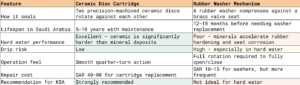
The cartridge is the valve mechanism inside the tap that controls water flow. There are two fundamentally different technologies, and in Saudi Arabia’s hard water environment, the difference in performance between them is dramatic.
Kitchen Tap Finishes – What Lasts and What Doesn’t
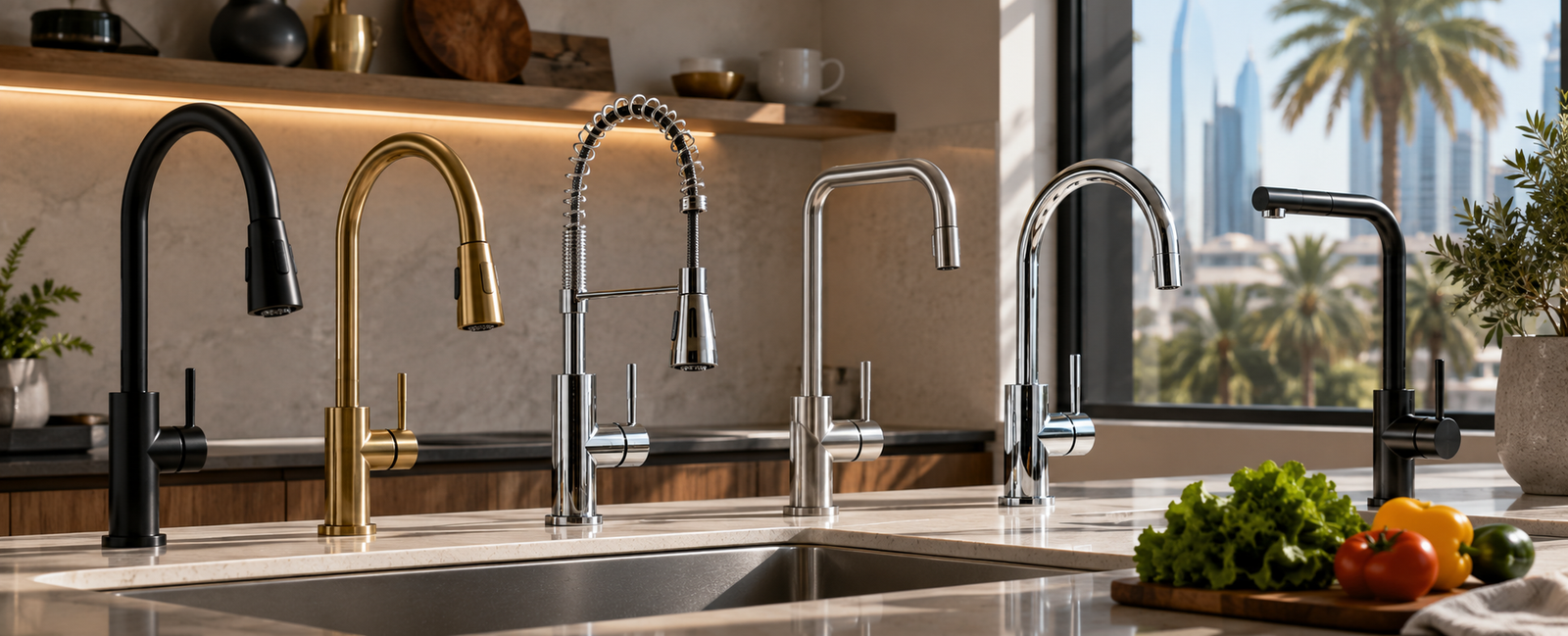
Finish choice is partly aesthetic and partly practical. In Saudi Arabia’s hard water environment, some finishes hide mineral deposits naturally while others require daily maintenance to stay presentable. Here’s a realistic view of each.
- Polished Chrome: Classic and easy to clean. Shows water spots but responds well to descaling.(Maintenance: Low–Medium)
- Brushed Stainless: Hides fingerprints and minor scale. The most forgiving finish for busy Saudi kitchens. (Maintenance: Low)
- Matte Black: Striking but demanding. Needs daily dry-wiping in hard water , deposits show clearly.(Maintenance: High)
- Brushed Gold / PVD: PVD-coated gold is durable. Shows deposits less than polished gold. Popular in Saudi premium kitchens.(Maintenance: Medium)
- Brushed Nickel: Warm tone, hides fingerprints well. Deposits settle into the brush texture — needs direction-of-grain cleaning. (Maintenance: Medium)
Best finish for Saudi kitchens
“Brushed stainless steel is the most practical choice for a working Saudi kitchen , it hides everyday mineral deposits, resists hard water, and doesn’t require the daily wiping that matte black or polished chrome demand. PVD brushed gold is the best choice if a premium aesthetic is the priority, since PVD coating is significantly more durable than standard lacquer-over-brass finishes.”
Features Worth Paying For
Not every feature on a kitchen tap spec sheet is equally valuable. Some are genuinely useful in daily Saudi kitchen use; others exist mainly to justify a higher price tag. Here’s an honest breakdown.
Features that earn their cost
- Pull-out or pull-down spray head with pause function , being able to pause the flow while repositioning the hose saves water and prevents spray-back. Not all pull-out taps have this; check the spec.
- 360° swivel spout , essential for double-bowl sinks. Less critical for single-bowl setups but still convenient for filling large pots off to the side of the sink.
- Aerator with easy hand-removal , in hard water areas, aerator access isn’t optional. Some taps require tools to unscrew the aerator cap; others twist off by hand. The latter is worth specifically looking for.
- Ceramic disc cartridge with separate hot and cold inlets , allows the cartridge to be replaced without disturbing the water supply connections. A detail that matters significantly at the 5-year repair point.
- Ceramic-lined supply hoses , standard rubber supply hoses can harden and crack in the heat under a Saudi sink. Braided stainless steel hoses are a small upcharge worth taking.
Features you can skip
- LED temperature indicators – colour-changing LEDs look impressive in a showroom. The electronics are not designed for hard water mineral ingress and typically fail within 1–2 years. The tap underneath is still functional, but you’ve paid extra for a feature that won’t last.
- Multiple spray mode buttons on the spray head – more moving parts mean more mineral-deposit accumulation and more buttons to fail. A two-mode spray (stream and spray) is sufficient for any kitchen task and more reliable than a five-mode system.
- Very long pull-out hoses (over 60cm) – past a certain length, the hose retraction becomes weaker and the risk of kinking increases. A 50–55cm hose covers every normal kitchen task without the retraction problems.
What to Check Before You Buy
This checklist applies whether you’re buying from a showroom, a hardware supplier, or an online marketplace.
Pre-Purchase Checklist for Saudi Arabia Kitchen Taps
- Body material confirmed as solid brass or 304 stainless steel – not zinc alloy
- Ceramic disc cartridge specified – not rubber washer mechanism
- SASO compliance documentation available from the supplier
- Mounting hole diameter matches your sink (35mm standard, but verify)
- Supply hose connections match your pipe size (15mm / ½” is standard in KSA)
- Replacement cartridges available in Saudi Arabia – not an import-only part
- Aerator is user-removable by hand or with standard tools
- Warranty terms specify what’s covered and for how long (minimum 2 years for quality taps)
- If pull-out: retraction mechanism is spring or magnetic (not just gravity-return)
- Supply hoses are braided stainless steel, not plain rubber
Red flags when buying a kitchen tap in Saudi Arabia
No SASO compliance mentioned anywhere. “Chrome-plated stainless” used to describe the body (this usually means zinc alloy with a stainless-look coating). A weight that feels very light for a metal tap. No mention of cartridge type in the specification. Warranty limited to 6 months. These are all signs of a tap built to a price point that won’t survive Saudi water conditions past the second year.
Price vs Performance — Finding the Right Budget
Kitchen taps in Saudi Arabia range from under SAR 100 to several thousand for imported European brands. The good news is you don’t need to spend at the top of that range to get a tap that performs well. But there is a floor below which you’re making a false economy.
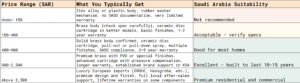
For most Saudi households, the SAR 400–900 range hits the ideal balance , you’re getting a genuinely durable tap with the right spec for local conditions, without paying the significant premium of a luxury import. At this range, KanzotechFaucets designs specifically for the Saudi market: brass bodies, ceramic disc mechanisms, SASO-compliant, and with replacement cartridges stocked locally.
KEY TAKEAWAYS
- Saudi Arabia’s hard water makes body material and cartridge type the two most important decisions – not aesthetics.
- Always choose solid brass or 304 stainless steel body. Zinc alloy fails faster in Saudi water conditions.
- Ceramic disc cartridges outperform rubber washer mechanisms significantly in hard water – fewer drips, longer life.
- Single-lever mixer taps with pull-out or pull-down spray are the most practical choice for Saudi kitchen use.
- Brushed stainless steel is the most low-maintenance finish in hard water environments. Matte black requires daily care.
- SASO compliance is not optional — it protects you legally and ensures the product was designed for local conditions.
- The SAR 400–900 range provides the best performance-to-cost ratio for most Saudi homes.
- Check that replacement cartridges are available locally before buying – import-only parts make future repairs expensive.
Frequently Asked Questions
1.What is the best type of kitchen tap for Saudi Arabia?
A single-lever mixer tap with a ceramic disc cartridge and a solid brass or 304 stainless steel body is the best all-round choice. It handles hard water better than rubber washer mechanisms, operates with one hand, and delivers consistent performance in the temperature extremes common in Saudi kitchens. Add a pull-out or pull-down spray head and you have a tap that covers every daily kitchen task.
2.Should I buy a pull-down or pull-out kitchen faucet?
Pull-down faucets suit deeper sinks and are better for rinsing large pots and pans — the high arc and downward spray direction give you more clearance and more force. Pull-out faucets work better with standard-depth single-bowl sinks and give more lateral reach around the sink area. For most Saudi kitchens with standard sink depths, a pull-out is the more flexible day-to-day choice. If you have a deep double-bowl setup, pull-down is superior.
3.What does SASO compliance mean for kitchen faucets in Saudi Arabia?
SASO (Saudi Standards, Metrology and Quality Organization) certifies that a plumbing product meets the Kingdom’s specific safety and performance requirements. This includes pressure range testing, material lead content, and performance under the mineral-heavy water conditions found in Saudi Arabia. For residential buyers it means the product was engineered for local conditions. For commercial projects it’s a legal requirement. Always ask a supplier to confirm SASO compliance before purchasing.
4.How long should a kitchen faucet last in Saudi Arabia?
A quality brass-body tap with a ceramic disc cartridge should last 10–15 years in Saudi Arabia with proper maintenance — primarily cleaning the aerator every 4–6 weeks and descaling annually. Budget zinc alloy or plastic-body taps typically fail in 2–4 years under local conditions. The upfront cost difference between a SAR 200 tap and a SAR 600 tap looks significant, but over a 10-year horizon the cheaper option almost always costs more in replacements and repairs.
5.Is matte black a practical finish for a kitchen tap in Saudi Arabia?
It can be, but it requires commitment. Matte black is a powder-coated finish that shows mineral deposits and water spots more clearly than any other common tap finish. In Saudi Arabia’s hard water environment, this means wiping the tap dry after every use every time. If that’s a routine you’ll actually maintain, it’s viable. If not, brushed stainless or brushed nickel will look better over time with far less effort.
6.Can I install a kitchen tap myself in Saudi Arabia?
Yes, for a like-for-like replacement of an existing deck-mounted tap. The process involves shutting the isolation valve, disconnecting supply hoses, unbolting the old tap from beneath the sink, fitting the new tap through the existing hole, connecting the hoses, and testing for leaks. It takes 30–60 minutes with basic tools. Where you’ll need a plumber is if you’re changing from a deck mount to a wall mount, if your supply pipes need rerouting, or if there are no isolation valves under the sink.



 August 29, 2026
 HYZAM KENZ



Comments
No comments yet. Be the first to comment!